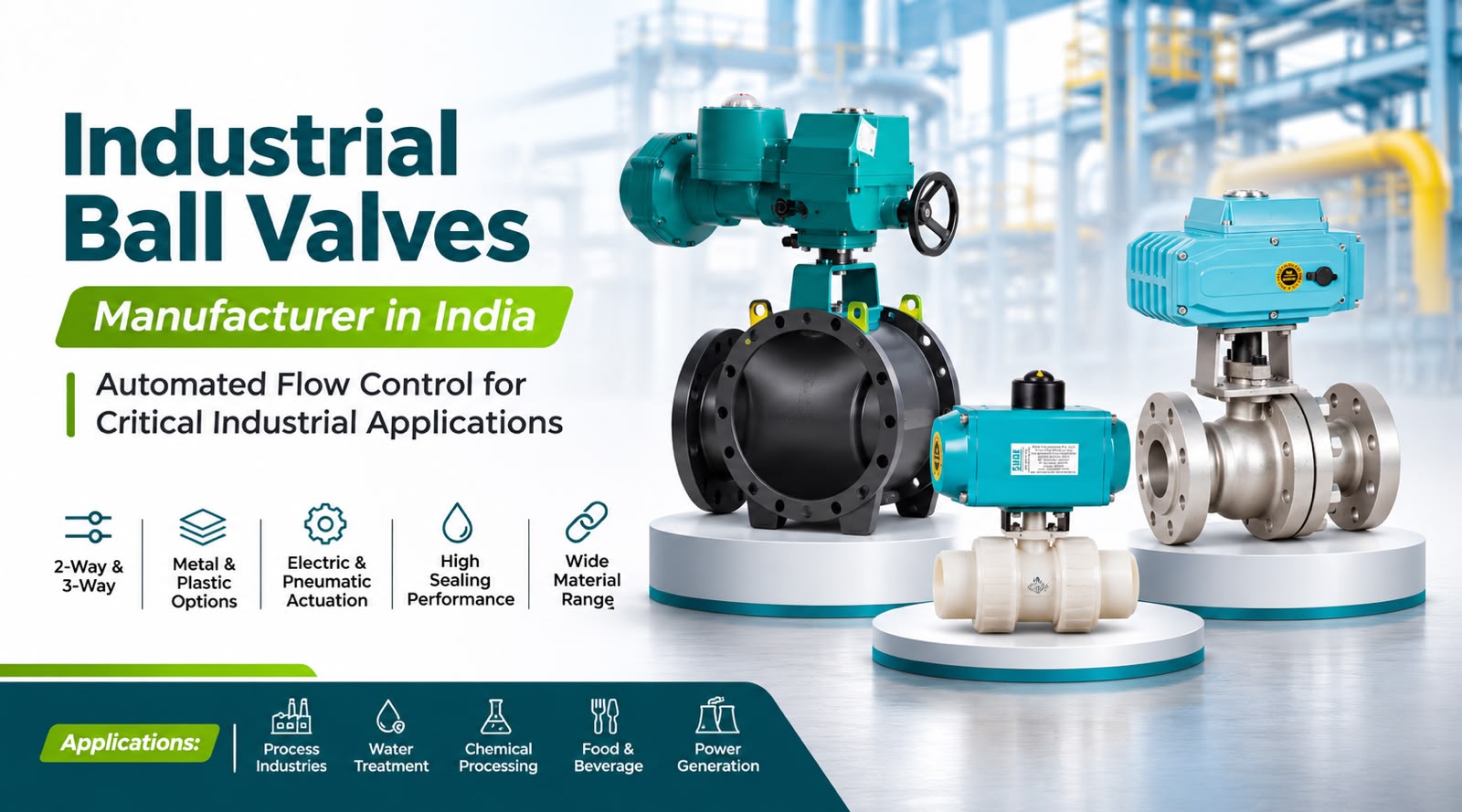

Sluice & Gate Valves for Water and Wastewater Plants: Types, Applications & Selection
- Valve
- Nov 12, 2026
- 2 Views
Sluice & Gate Valves for Water and Wastewater Plants: Types, Applications & Selection
Water distribution networks, wastewater treatment facilities and municipal infrastructure require reliable valve systems to manage the movement of water and isolate pipeline sections when required. From large transmission pipelines to pumping stations and sewage networks, selecting the right isolation valve is essential for dependable system operation.
Sluice valves and gate valves are widely used in these applications because of their full-bore design, linear operating mechanism and ability to provide reliable shut-off.
An industrial sluice or gate valve works by moving a gate perpendicular to the direction of flow. When fully open, it provides an unobstructed flow passage with minimal pressure loss. When closed, the gate moves against the seating surfaces to isolate the pipeline.
SUDE Engineering Pvt. Ltd. offers a range of Electric, Pneumatic and Hydraulic Operated Sluice / Gate Valves designed for water distribution, sewage systems, drainage networks, irrigation infrastructure and industrial utility applications.
With three operating configurations, precision-machined wedge and seat rings, protective coatings and automation options, SUDE provides isolation solutions for demanding water and wastewater infrastructure.
What Is a Sluice / Gate Valve?
A sluice or gate valve is a linear-motion isolation valve used to start or stop fluid flow through a pipeline.
The operating mechanism moves a gate vertically into or out of the flow passage.
When the gate is fully raised, water can pass through the valve with minimal obstruction. When lowered, the gate seats against the sealing surfaces to stop the flow.
SUDE groups these products under its Sluice / Gate Valve range.
These valves are commonly used in:
Municipal water distribution networks.
Sewage and drainage pipelines.
Water treatment plants.
Wastewater infrastructure.
Pumping stations.
Irrigation systems.
Canal and penstock systems.
Industrial utility pipelines.
Fire protection systems.
Their primary function is pipeline isolation rather than continuous flow throttling.
Explore the SUDE Sluice / Gate Valve product range.
Types of Sluice / Gate Valves Available at SUDE Engineering
SUDE offers three principal operating configurations for industrial and water infrastructure applications.
1. Electric Operated Sluice / Gate Valve – 9650 Series
The 9650 Series is designed for applications requiring automated isolation and remote valve operation.
The valve operates through a three-phase multi-turn electric actuator that rotates the actuator spindle to raise or lower the wedge.
This arrangement allows the valve to be operated remotely and integrated with PLC and DCS control systems.
Key features:
DN50 to DN1200 size range.
Three-phase multi-turn electric actuator.
Precision-machined wedge and seat rings.
Full-bore flow passage.
Fusion Bonded Epoxy (FBE) internal and external coating.
Remote ON/OFF operation.
PLC/DCS integration.
Position feedback and limit-switch options.
The product page also lists optional accessories such as position transmitters, potentiometers, integral starters, local control panels and MODBUS communication.
Applications:
Water distribution networks.
Clear water services.
Sewage systems.
Plumbing networks.
Infrastructure pipelines.
Automated utility lines.
Explore SUDE Electric Operated Sluice / Gate Valve – 9650 Series.
2. Pneumatic Cylinder Operated Sluice / Gate Valve – 9660 Series
The 9660 Series is designed for automated isolation applications where compressed air is available for valve operation.
It uses a double-acting or single-acting pneumatic cylinder to generate the linear movement required to raise and lower the gate.
A directional control arrangement regulates the operating movement, allowing smooth opening and closing.
Key features:
DN50 to DN450 size range.
Double-acting or single-acting pneumatic cylinder.
Cylinder sizes from 65 mm to 350 mm.
Air supply pressure up to 8 bar.
Flanged end connections.
Manual override option.
Solenoid valve-operated control.
Electro-pneumatic automation compatibility.
Additional accessories include solenoid valves, air filter regulators, limit switches, position indicators, electro-pneumatic positioners and extension shafting.
Applications:
Municipal pipelines.
Automated water-handling networks.
Utility isolation systems.
Industrial infrastructure.
HVAC installations.
Fire protection systems.
Explore SUDE Pneumatic Cylinder Operated Sluice / Gate Valve – 9660 Series.
3. Hydraulic Cylinder Operated Sluice / Gate Valve – 9670 Series
The 9670 Series is designed for heavy-duty isolation applications where large valve sizes, higher operating forces or controlled actuation are required.
The valve uses a hydraulic cylinder to generate linear movement.
Hydraulic oil drives the piston, which raises or lowers the gate through the operating spindle. Directional control valves regulate the movement for smooth operation.
Key features:
DN100 to DN2000 size range.
Larger sizes available on request.
Hydraulic cylinder operation.
Single-acting and double-acting cylinder options.
Hydraulic power pack.
Directional control valves.
Pressure relief valve.
Fusion Bonded Epoxy or industrial-grade protective coating.
Position indicators and limit-switch options.
Applications:
Water works.
Dams.
Hydro projects.
Irrigation systems.
Penstock systems.
Flood-control gates.
Canal isolation valves.
Cooling-water pipelines.
Heavy-duty water infrastructure.
Explore SUDE Hydraulic Cylinder Operated Sluice / Gate Valve – 9670 Series.
How Does a Sluice / Gate Valve Work?
The working principle of a sluice or gate valve is based on linear movement.
The gate moves perpendicular to the direction of fluid flow to open or close the pipeline.
1. Open Position
When the valve is fully open, the wedge or gate moves upward, clearing the flow passage.
This provides full-bore flow with minimal obstruction.
2. Closing Movement
The operating mechanism moves the spindle or cylinder to lower the gate vertically.
The gate approaches the valve seat and gradually closes the flow passage.
3. Closed Position
The wedge seats firmly against the corresponding seating surfaces, providing tight shut-off.
The operating mechanism holds the gate in its closed position.
Since these valves are principally designed for isolation, they should not be treated as continuous throttling devices.
Electric vs Pneumatic vs Hydraulic Sluice Valves
Choosing the right actuation system depends on the size of the valve, operating requirements and available utilities.
Parameter | Electric – 9650 | Pneumatic – 9660 | Hydraulic – 9670 |
|---|---|---|---|
Operating mechanism | Multi-turn actuator | Air cylinder | Hydraulic cylinder |
Published size range | DN50–DN1200 | DN50–DN450 | DN100–DN2000 |
Primary advantage | Remote automation | Compressed-air operation | High operating force |
Control | PLC/DCS integration | Solenoid and pneumatic control | Hydraulic power pack |
Manual option | As specified by configuration | Manual override | As specified by configuration |
Typical applications | Automated water networks | Municipal pipelines | Dams and large water infrastructure |
Each configuration serves a different operating requirement. The final selection should consider the valve size, design pressure, available utilities, required operating time and site conditions.
Technical Specifications of SUDE Sluice / Gate Valves
SUDE publishes the following specifications across its three operating series.
Technical parameter | 9650 Series | 9660 Series | 9670 Series |
|---|---|---|---|
Valve type | Electric operated | Pneumatic cylinder operated | Hydraulic cylinder operated |
Size | DN50–DN1200 | DN50–DN450 | DN100–DN2000 |
Standard temperature | Up to 80°C | Up to 80°C | Up to 80°C |
Operating principle | Wedge gate | Wedge gate | Wedge gate |
Actuator | Three-phase multi-turn | Single / double acting cylinder | Single / double acting cylinder |
Protective coating | FBE internal and external | Corrosion-resistant coating | FBE / industrial protective coating |
End connection | As specified | Flanged | As specified |
Pressure ratings are configuration- and size-dependent. SUDE publishes multiple PN ratings across its product range, so the approved product datasheet should be checked for the exact valve size and specification before ordering.
Importance of Corrosion Protection in Water and Wastewater Systems
Water treatment plants, wastewater facilities and marine installations often operate in environments where moisture, corrosive media and pressure variations can affect equipment durability.
SUDE identifies corrosion, high humidity, pressure fluctuations and continuous operation among the major challenges faced by water and wastewater installations.
Protective coatings therefore play an important role in extending the service life of industrial valves.
The Electric Operated 9650 Series specifically uses Fusion Bonded Epoxy (FBE) coating on both internal and external surfaces.
For hydraulic configurations, SUDE also lists FBE and industrial-grade protective coating options.
The appropriate coating and construction materials should be selected according to water quality, chemical exposure, installation conditions and project requirements.
Applications of Sluice / Gate Valves in Water and Wastewater Plants
1. Municipal Water Distribution Networks
Municipal water distribution networks require isolation valves at different points to manage pipelines and connected infrastructure.
Sluice and gate valves can isolate pipeline sections during maintenance or operational changes.
SUDE's electric and pneumatic configurations support automated operation in water distribution applications.
2. Sewage and Wastewater Systems
Sewage infrastructure requires suitable isolation equipment across connected pipelines and utility systems.
SUDE identifies sewage systems and drainage networks among the applications of its Sluice / Gate Valve range.
The selected configuration should match the characteristics of the wastewater, including suspended solids, pressure and other operating conditions.
3. Water Treatment Plants
Water treatment facilities require reliable isolation equipment for different sections of their pipeline networks.
SUDE's Water & Wastewater portfolio addresses applications involving municipal water supply, effluent treatment and other water infrastructure requirements.
4. Pumping Stations
Pumping stations require suitable isolation arrangements around connected water pipelines and equipment.
Electric, pneumatic and hydraulic sluice valves can be selected according to the size and operating requirements of the installation.
5. Irrigation Systems and Canal Networks
Large irrigation schemes and canal infrastructure require valves capable of isolating water flow at designated locations.
SUDE's hydraulic cylinder-operated 9670 Series is identified for irrigation systems and canal isolation applications.
6. Dams and Penstock Systems
Dams and hydroelectric installations require dependable isolation arrangements in large water-handling infrastructure.
SUDE's hydraulic sluice/gate valves are designed for suitable applications involving penstock systems, dams and heavy-duty water infrastructure.
Explore SUDE Water & Wastewater Industry Solutions.
How to Select the Right Sluice / Gate Valve
Selecting a suitable valve requires careful consideration of the operating conditions and application requirements.
1. Pipeline Diameter
Identify the required nominal valve size and ensure it matches the pipeline and installation arrangement.
2. Operating Pressure
Confirm normal and maximum design pressure requirements.
The valve pressure rating must be appropriate for the specific size and configuration.
3. Operating Temperature
Evaluate the normal operating temperature and select a suitable valve configuration.
SUDE publishes a standard operating temperature of up to 80°C across the three listed product configurations, with higher temperatures available on request.
4. Water or Wastewater Characteristics
Identify whether the application handles clear water, sewage, effluent or other process media.
The media characteristics influence material, sealing and protective-coating selection.
5. Actuation Requirement
Choose electric, pneumatic or hydraulic operation according to available utilities and the required operating mechanism.
6. Corrosion Protection
Evaluate the coating and construction materials required for the installation environment.
7. Automation and Feedback
For automated installations, consider remote operation, limit switches, position transmitters, control panels and PLC/DCS integration where appropriate.
8. Installation and Maintenance
Consider accessibility, actuator space, installation orientation and maintenance requirements before finalizing the valve design.
A properly prepared technical specification helps ensure that the selected valve matches the pipeline and operating conditions.
Why Choose SUDE Engineering for Sluice / Gate Valves?
SUDE Engineering offers electric, pneumatic and hydraulic operated sluice/gate valves for water infrastructure, municipal pipelines and industrial utility applications.
Its 9650, 9660 and 9670 series address different valve sizes and operating requirements.
Key product advantages include:
Three operating configurations.
Full-bore gate valve design.
Precision-machined wedge and seat rings.
Tight shut-off performance.
Corrosion-resistant coating options.
Electric actuator integration.
Pneumatic cylinder operation.
Hydraulic power-pack operation.
Position feedback and automation accessories.
Application-specific configurations for water infrastructure.
For product information and project requirements, explore the SUDE Sluice / Gate Valve Range.
Frequently Asked Questions About Sluice / Gate Valves
1. What is a sluice valve used for?
A sluice valve is used to start or stop water flow through a pipeline. It is commonly used in water distribution networks, sewage systems, drainage pipelines and municipal infrastructure.
2. What is the difference between a sluice valve and a gate valve?
SUDE groups these products together under its Sluice / Gate Valve category. Both terms are used for linear-motion gate isolation valves within this product range.
3. Which types of gate valves does SUDE offer?
SUDE offers Electric Operated 9650 Series, Pneumatic Cylinder Operated 9660 Series and Hydraulic Cylinder Operated 9670 Series.
4. What is the size range of SUDE electric sluice valves?
The published size range of the 9650 Series is DN50 to DN1200.
5. What is the maximum size of SUDE hydraulic sluice valves?
The 9670 Series is available from DN100 to DN2000, with larger sizes available on request.
6. Are pneumatic gate valves suitable for water distribution systems?
SUDE's 9660 Series is designed for automated isolation in municipal pipelines and water-handling networks where compressed-air actuation is suitable.
7. Are SUDE sluice valves suitable for wastewater applications?
SUDE identifies sewage systems, drainage networks and wastewater-related infrastructure among its application areas. The exact configuration should be selected according to the characteristics of the wastewater.
8. Which actuator is suitable for large sluice valves?
The selection depends on valve size, operating force, available utilities and project conditions. SUDE's hydraulic 9670 Series is specifically designed for heavy-duty applications involving large valves and higher operating forces.
9. What coating is available for SUDE sluice valves?
SUDE lists Fusion Bonded Epoxy coating for the 9650 Series, and FBE or industrial-grade protective coating options for the hydraulic 9670 Series.
Conclusion
Water distribution networks and wastewater infrastructure require dependable isolation valves capable of operating under continuous-duty conditions.
Sluice and gate valves play an important role in managing pipeline isolation across municipal water supply, sewage, drainage, irrigation and heavy-duty water infrastructure.
SUDE Engineering's 9650, 9660 and 9670 series provide electric, pneumatic and hydraulic operating configurations for different industrial and water infrastructure requirements.
For organizations looking for a Sluice Valve Manufacturer in India, SUDE Engineering offers application-specific gate valve solutions with full-bore construction, precision-machined wedge and seat rings, protective coatings and automated operating options.
Explore the SUDE Sluice / Gate Valve Range or contact SUDE Engineering for technical specifications and project enquiries.
Related Posts
- Nov 18, 2026
- SUDE
- 10
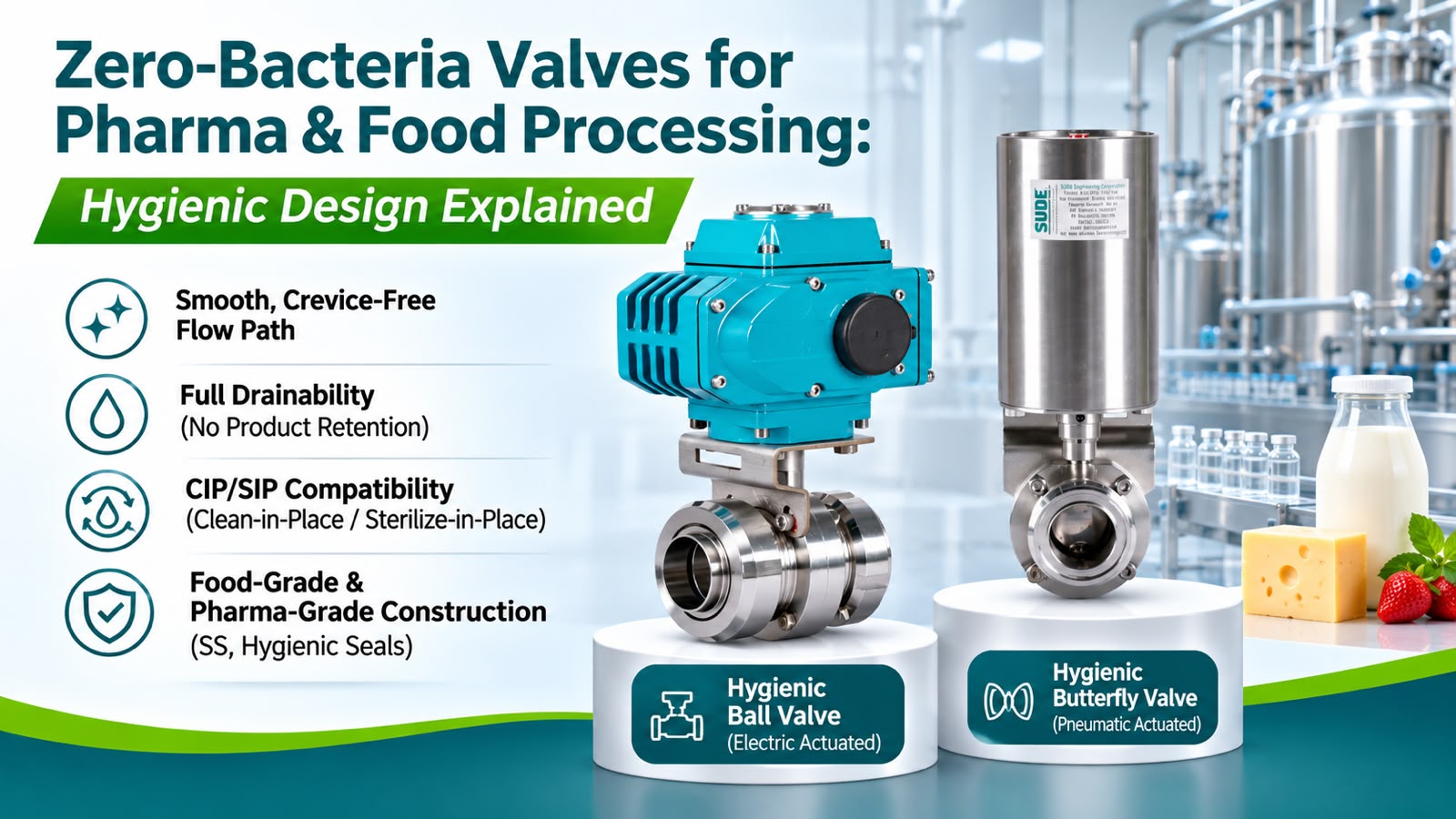
Zero-Bacteria Valves for Pharma & Food Processing: Hygienic Design Explained
Explore More