
Zero-Bacteria Valves for Pharma & Food Processing: Hygienic Design Explained
- Valve
- Nov 18, 2026
- 4 Views
Zero-Bacteria Valves for Pharma & Food Processing: Hygienic Design Explained
In pharmaceutical and food processing industries, maintaining product purity is just as important as controlling fluid flow. Even minor contamination within a processing line can affect product quality, create hygiene risks and lead to costly production interruptions.
This is why hygienic valve design plays an important role in modern manufacturing facilities.
Unlike conventional industrial valves, hygienic valves are designed to minimise product retention, reduce contamination risks and support effective cleaning and sterilisation procedures. Smooth internal surfaces, suitable wetted materials, hygienic connections and drainable construction are important considerations when selecting valves for sensitive applications.
Zero-bacteria valves are developed around these requirements. They are commonly used in pharmaceutical manufacturing, food and beverage production, dairy processing, biotechnology and other industries where maintaining product integrity is essential.
SUDE Engineering Pvt. Ltd. offers a dedicated range of Zero Bacteria Ball and Butterfly Valves with electric and pneumatic actuation options, designed for hygienic and food-grade processing applications.
Let's understand how these valves work, what makes their design hygienic and how to select the right configuration for your facility.
What Are Zero-Bacteria Valves?
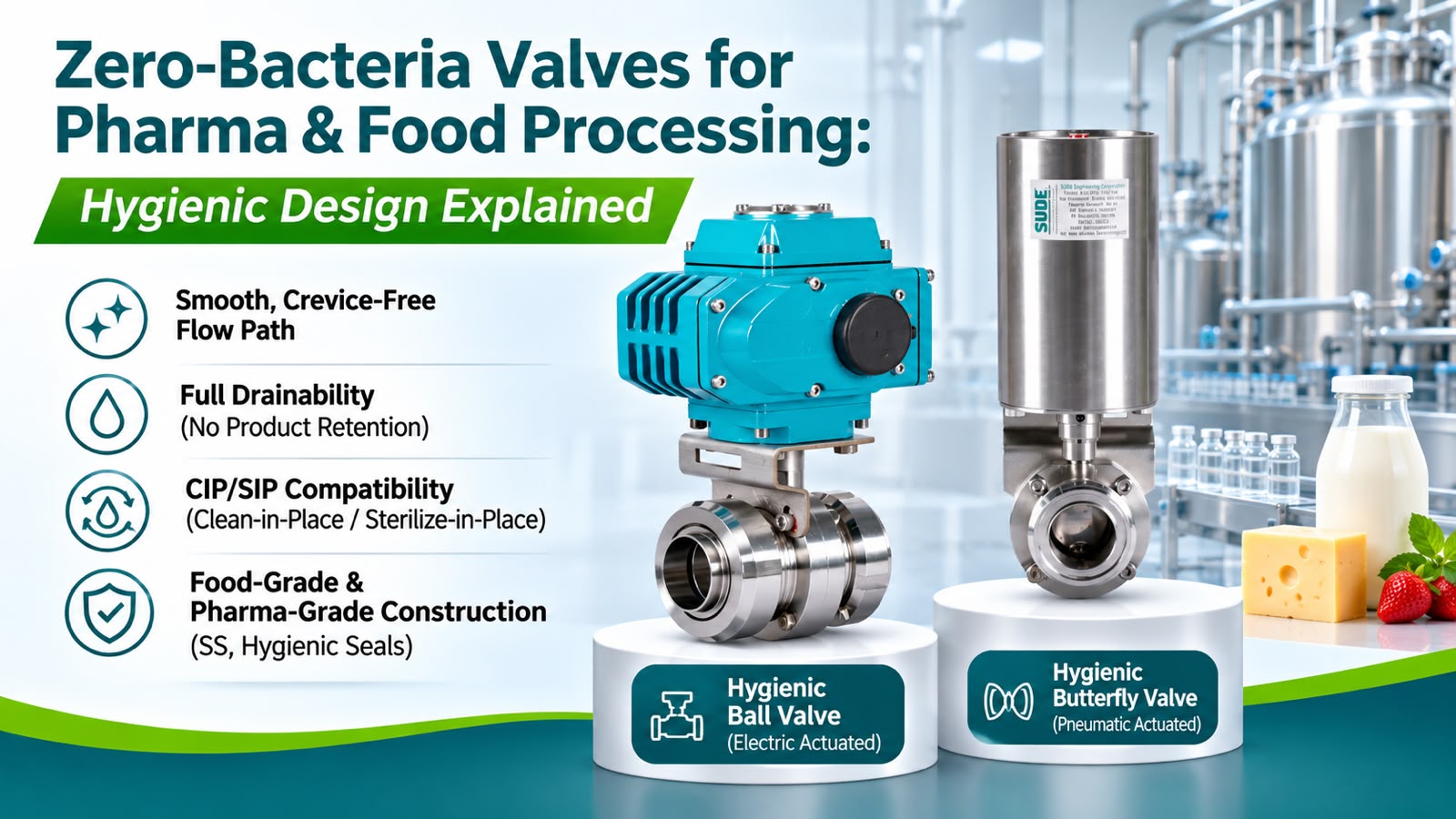
Zero-bacteria valves are specialised hygienic flow-control valves designed to minimise microbial contamination, product residue and unwanted material accumulation within processing systems.
They are particularly important in applications where the same equipment handles products that require strict hygiene controls.
Conventional industrial valve designs may contain internal cavities, crevices or areas where residual product can accumulate. If these areas are difficult to clean, they may create conditions that increase contamination risks.
Hygienic valve designs address these challenges through:
Smooth and crevice-free internal surfaces.
Suitable food-grade wetted materials.
Full-drainability considerations.
Reduced product retention.
Hygienic end connections.
Compatibility with CIP and SIP procedures.
Appropriate sealing and shut-off arrangements.
SUDE's Zero Bacteria Valve category specifically identifies these features as part of its hygienic valve design approach.
It is important to understand that the term zero bacteria describes the intended hygienic design objective. Actual microbial control depends on the complete processing system, cleaning procedures, sterilisation conditions and validation.
Why Is Hygienic Valve Design Important in Pharma and Food Processing?
Pharmaceutical and food manufacturing facilities handle products that require carefully controlled processing environments.
Valves are installed throughout these facilities to manage ingredients, purified water, intermediate products, cleaning fluids and finished-product transfer.
If a valve is not designed for the intended hygiene requirements, product residues can remain inside the equipment and create cleaning challenges.
1. Prevention of Product Contamination
Hygienic valve construction helps minimise areas where microorganisms and product residues may accumulate.
This is particularly important when processing sterile pharmaceutical products, dairy products, beverages and other contamination-sensitive materials.
2. Improved Cleaning Efficiency
Valves used in hygienic processing lines should support effective cleaning procedures.
Smooth internal surfaces, suitable flow paths and compatible sealing materials help improve cleaning effectiveness.
3. Reduced Product Retention
Product retention can create cleaning difficulties and increase the risk of cross-contamination between production batches.
Drainable construction helps minimise retained fluid after the process is completed.
4. Consistent Production Quality
Maintaining hygienic conditions throughout the processing line supports consistent product quality and reduces the possibility of contamination-related production interruptions.
Important Hygienic Design Features of Zero-Bacteria Valves
Selecting a hygienic valve requires more than simply choosing a stainless steel body. Its internal construction, sealing arrangement and cleaning compatibility are equally important.
1. Smooth Internal Surface Finish
The internal surface finish directly affects the cleanability of a valve.
Rough surfaces may provide locations where product residue and microorganisms can accumulate.
Hygienic valves therefore use smooth product-contact surfaces to support effective cleaning.
SUDE identifies smooth internal surfaces as a key feature of its Zero Bacteria Valve range.
2. Crevice-Free Construction
Crevices and inaccessible internal spaces can retain process material.
Hygienic valve designs aim to minimise these locations, reducing the possibility of product accumulation and making cleaning procedures more effective.
3. Full Drainability
Drainability is an important consideration in pharmaceutical and food processing systems.
A valve should be selected and installed in a configuration that allows process fluids and cleaning solutions to drain effectively.
Valve orientation and pipeline arrangement also influence drainage performance.
4. Food-Grade Material Selection
Materials that come into direct contact with the product must be compatible with the process medium and applicable food or pharmaceutical requirements.
SUDE's hygienic metallic valve range includes stainless steel construction options such as SS304, SS316 and SS316L across its published ball valve portfolio.
The suitability of each material should be confirmed against the actual process and applicable material documentation.
5. CIP and SIP Compatibility
Cleaning-in-Place (CIP) and Sterilisation or Steam-in-Place (SIP) procedures help maintain hygienic conditions without requiring complete equipment disassembly.
Valves used in these systems must be compatible with the cleaning chemicals, temperatures, pressures and operating cycles involved.
SUDE identifies CIP/SIP compatibility within its Zero Bacteria Valve category and sanitary valve offerings.
Types of Zero-Bacteria Valves Offered by SUDE Engineering
SUDE provides electric and pneumatic operated hygienic valve solutions, including ball and butterfly valve configurations.
1. Electric Operated Zero-Bacteria Ball Valves
Electric operated ball valves use an electric actuator to rotate the internal ball by 90 degrees, allowing the valve to open or close.
SUDE's electric metallic ball valve portfolio includes the following configurations:
Electric Operated Butt-Weld Metallic Ball Valve – 1357 Series.
Electric Operated I-Line Metallic Ball Valve.
Electric Operated Sanitary Clamp Ball Valve.
Hygienic and CIP/SIP-compatible configurations.
The electric actuator supports automated valve operation and can be integrated into suitable plant control systems.
Key advantages:
Automated ON/OFF operation.
Quarter-turn operating mechanism.
Hygienic connection options.
Stainless steel construction options.
Suitable configurations for pharmaceutical and food processing.
Automation accessories and control options.
Explore SUDE's Electric Operated Metal Ball Valves.
2. Pneumatic Operated Zero-Bacteria Ball Valves
Pneumatic operated ball valves use compressed air to operate the valve through a pneumatic actuator.
SUDE's pneumatic metallic ball valve range includes:
Pneumatic Operated Butt-Weld Metallic Ball Valve – 1367 Series.
Pneumatic Operated I-Line Metallic Ball Valve.
Pneumatic Operated Sanitary Clamp Ball Valve.
Two-way and three-way ball valve configurations.
Pneumatic actuation is particularly useful in automated process installations where compressed air is available.
Key advantages:
Pneumatic ON/OFF operation.
Double-acting and spring-return configurations.
Hygienic connection options.
Automation-ready construction.
Suitable for automated food and pharmaceutical processing lines.
Explore SUDE's Pneumatic Operated Metal Ball Valves.
3. Food-Grade Butterfly Valves
Butterfly valves use a rotating disc positioned inside the valve body to control fluid flow.
Their compact construction and quarter-turn operation make them useful in different processing and utility systems.
SUDE's product catalogue groups the 1257 and 1267 series within its food-grade ball and butterfly valve range.
The available electric and pneumatic configurations provide options for automated operation.
Key advantages:
Compact valve construction.
Quarter-turn operation.
Electric and pneumatic actuation options.
Suitable configurations for food-grade applications.
Integration with automated processing systems.
For applications requiring hygienic performance, the disc, seat, sealing materials, surface finish and drainability should all be evaluated.
Explore the SUDE Zero Bacteria Valve Range.
What Is the Difference Between Electric and Pneumatic Hygienic Valves?
Both operating configurations can be used in automated processing environments. The selection depends on available utilities, control requirements and installation conditions.
Parameter | Electric Operated | Pneumatic Operated |
|---|---|---|
Operating source | Electrical power | Compressed air |
Operation | Electric actuator | Pneumatic actuator |
Control | Electrical control signals | Solenoid / pneumatic control |
Automation | PLC / control system integration | PLC / solenoid integration |
Manual operation | Optional, configuration-dependent | Optional, configuration-dependent |
Typical selection factor | Electrical availability and positioning needs | Compressed-air availability and operating requirements |
Electric operation is useful where electrical automation and positioning are required.
Pneumatic operation is suitable where a reliable compressed-air supply is available and the process requires automated valve operation.
The final choice should also consider actuator protection, operating frequency, fail-safe requirements and the surrounding environment.
Applications of Zero-Bacteria Valves
Hygienic valves are used across several industries where product purity and contamination control are important.
1. Pharmaceutical Manufacturing
Pharmaceutical facilities use hygienic valves in purified water systems, clean utilities, ingredient transfer lines and selected product-processing applications.
Suitable valve construction helps support cleaning procedures and contamination-control requirements.
2. Food and Beverage Processing
Food and beverage facilities handle liquids, ingredients, syrups and finished products through interconnected processing lines.
Hygienic ball and butterfly valves are used in suitable applications for isolation and flow management.
3. Dairy Processing
Milk, cream and other dairy products require controlled processing and effective cleaning between production cycles.
Hygienic valve designs help reduce product retention and support cleaning procedures.
4. Biotechnology
Biotechnology facilities require careful control over process materials and contamination risks.
Suitable hygienic valves are used in selected fluid-handling and clean-utility systems.
5. Brewing and Beverage Production
Brewing and beverage facilities handle ingredients, process water and finished liquids through multiple processing stages.
Hygienic valve configurations help support product handling and cleaning requirements.
6. Cosmetic Manufacturing
Cosmetic manufacturing involves creams, liquid formulations, oils and other products that require controlled handling.
Suitable hygienic valves help manage these materials while supporting cleaning between batches.
Zero-Bacteria Valves vs Conventional Industrial Valves
The main difference lies in their intended application and construction requirements.
Parameter | Hygienic Zero-Bacteria Valve | Conventional Industrial Valve |
|---|---|---|
Primary requirement | Contamination-risk reduction | General industrial flow control |
Internal design | Smooth, hygienic surfaces | Depends on valve design |
Product retention | Designed to minimise retention | May contain difficult-to-clean areas |
Drainability | Important design consideration | Not always a primary requirement |
Cleaning | Designed for specified hygienic cleaning procedures | Depends on construction |
Materials | Suitable food/pharma wetted materials | Selected according to industrial service |
Typical industries | Pharma, food, dairy, biotech | Water, power, oil, gas and general industry |
A conventional valve is not automatically unsuitable for hygienic service. However, it must meet the specific requirements of the process before being selected for food or pharmaceutical applications.
How to Select the Right Hygienic Valve for Your Facility
Choosing the right hygienic valve requires a detailed understanding of the application.
Consider these factors before finalising your selection:
1. Process Medium
Identify the fluid being handled, including its chemical composition, viscosity and operating characteristics.
2. Wetted Material Compatibility
Select suitable stainless steel grades, sealing materials and other wetted components according to the process requirements.
3. Surface Finish
Check the required internal surface roughness and whether electropolishing is necessary.
4. Connection Type
Consider Tri-Clamp, butt-weld, I-Line or other hygienic connections depending on the pipeline design.
5. Cleaning and Sterilisation
Confirm compatibility with the facility's CIP/SIP chemicals, temperatures, pressures and cleaning cycles.
6. Drainability
Evaluate valve orientation, installation position and internal geometry to minimise retained fluid.
7. Automation Requirements
Determine whether electric or pneumatic actuation is better suited to the available utilities and control system.
8. Documentation and Compliance
Request material certificates, applicable FDA material declarations, surface-finish documentation and relevant cleaning or validation information for the exact valve configuration.
A proper technical review helps ensure the valve is suitable for the actual processing environment rather than relying only on its product category.
Why Choose SUDE Engineering for Zero-Bacteria Valves?
SUDE Engineering offers specialised hygienic valve solutions for pharmaceutical, food and beverage, biotechnology and dairy processing applications.
Its product portfolio includes electric and pneumatic operated metallic ball valves, food-grade butterfly valves and hygienic diaphragm valve configurations.
Important product capabilities include:
Food-grade and hygienic valve configurations.
Electric and pneumatic actuation.
Butt-weld and sanitary connection options.
Stainless steel construction options.
Hygienic and CIP/SIP-compatible product configurations.
Automated ON/OFF operation.
Application-specific valve selection.
For additional hygienic processing requirements, SUDE also offers its 1168 Series pneumatic diaphragm-seated stainless steel valves, featuring SS316L construction, EPDM/PTFE sealing options, Tri-Clamp connections and an internal surface finish of Ra ≤ 0.4 μm.
Explore the SUDE Zero Bacteria Valve Range for product configurations and application details.
Frequently Asked Questions About Zero-Bacteria Valves
1. What is a zero-bacteria valve?
A zero-bacteria valve is a hygienic valve designed to minimise microbial contamination risks through suitable materials, smooth internal surfaces, reduced product retention and effective cleaning compatibility.
2. Where are zero-bacteria valves used?
They are used in pharmaceutical manufacturing, food and beverage processing, dairy, biotechnology, brewing, cosmetics and high-purity water systems.
3. What is the difference between a hygienic valve and a conventional valve?
Hygienic valves are designed around contamination control, cleanability, suitable wetted materials and product drainage. Conventional industrial valves are selected primarily according to their general process and operating requirements.
4. Are zero-bacteria valves compatible with CIP and SIP?
SUDE identifies CIP/SIP-compatible configurations within its hygienic valve portfolio. Compatibility should be confirmed for the exact valve model, sealing materials and cleaning conditions.
5. Which materials are used in hygienic ball valves?
Commonly selected materials include SS304, SS316 and SS316L stainless steel. The correct material depends on the process medium and applicable hygienic requirements.
6. What is the difference between electric and pneumatic hygienic valves?
Electric valves use electrical actuators for automated operation, while pneumatic valves use compressed air. Both can be integrated into suitable automated processing systems.
7. Are hygienic butterfly valves suitable for food processing?
Yes, suitable food-grade butterfly valve configurations can be used in food processing systems. Their wetted materials, disc design, seat, surface finish and cleaning compatibility must be verified.
8. Does a zero-bacteria valve guarantee complete sterilisation?
No. Hygienic valve construction helps reduce contamination risks, but complete microbial control depends on the overall system design, validated cleaning and sterilisation procedures, installation and operating conditions.
9. Which SUDE series are available for zero-bacteria valves?
SUDE's product catalogue identifies Series 1257, 1267, 1357 and 1367 under its food-grade ball and butterfly valve range, with electric and pneumatic operating configurations.
10. How do I select a hygienic valve for pharmaceutical manufacturing?
Evaluate the process medium, stainless steel grade, internal surface finish, connection type, sealing materials, CIP/SIP requirements, drainability and applicable documentation before selecting the valve.
Conclusion
Maintaining product purity in pharmaceutical and food processing facilities requires careful attention to every component in the processing line.
Hygienic valves play an important role in minimising contamination risks, reducing product retention and supporting effective cleaning and sterilisation procedures.
SUDE Engineering offers electric and pneumatic operated zero-bacteria ball and butterfly valve configurations designed for hygienic processing requirements.
With suitable material options, hygienic connection arrangements and automated operation, these valves provide flow-control solutions for pharmaceutical, food and beverage, dairy and biotechnology applications.
If you are looking for Zero Bacteria Valves for pharmaceutical or food processing applications, explore SUDE Engineering's product range and consult its engineering team to identify a suitable valve configuration for your facility.
Related Posts