

Industrial Valve Manufacturer India: Types
- Damper
- Jul 01, 2026
- 160 Views
Industrial Valve Manufacturer India: Types
Industrial valves are critical components in systems that transport, isolate, regulate, divert, or control liquids and gases. They are used across power generation, oil and gas, steel, cement, chemical processing, pharmaceuticals, water infrastructure, food processing, and other industrial sectors.
As industries in India continue to modernise and expand, buyers are looking beyond basic valve supply. They increasingly need manufacturers that can understand process conditions, provide suitable materials and configurations, integrate actuation and automation, and support projects from engineering through commissioning.
This makes the selection of an industrial valve manufacturer in India an important technical and commercial decision.
SUDE Engineering is an Indian manufacturer specialising in valves, dampers, and actuation systems. The company was founded in 1989 and has manufacturing facilities in Alandi, Pune, along with offices in Mumbai and Chennai. SUDE states that it serves customers across India and international markets and focuses on engineered flow-control solutions for demanding industrial applications.
What Does an Industrial Valve Manufacturer Do?
An industrial valve manufacturer is responsible for much more than assembling and supplying a valve.
Depending on the application, the manufacturer may be involved in:
Valve design and engineering
Material selection
Pressure and temperature rating
End-connection selection
Actuation and automation
Manufacturing and fabrication
Inspection and testing
Documentation and traceability
Customisation for project requirements
Technical support and after-sales service
The correct valve depends on the process rather than simply the pipe size. Fluid characteristics, pressure, temperature, flow rate, corrosiveness, solids content, frequency of operation, required shut-off performance, and automation requirements can all influence the final selection.
This is why working directly with an experienced industrial valve manufacturer can be advantageous for technically demanding projects.
Types of Industrial Valves
Industrial valve requirements vary considerably between industries. A manufacturer with a broad product portfolio can support different applications without forcing the same valve design into every service.
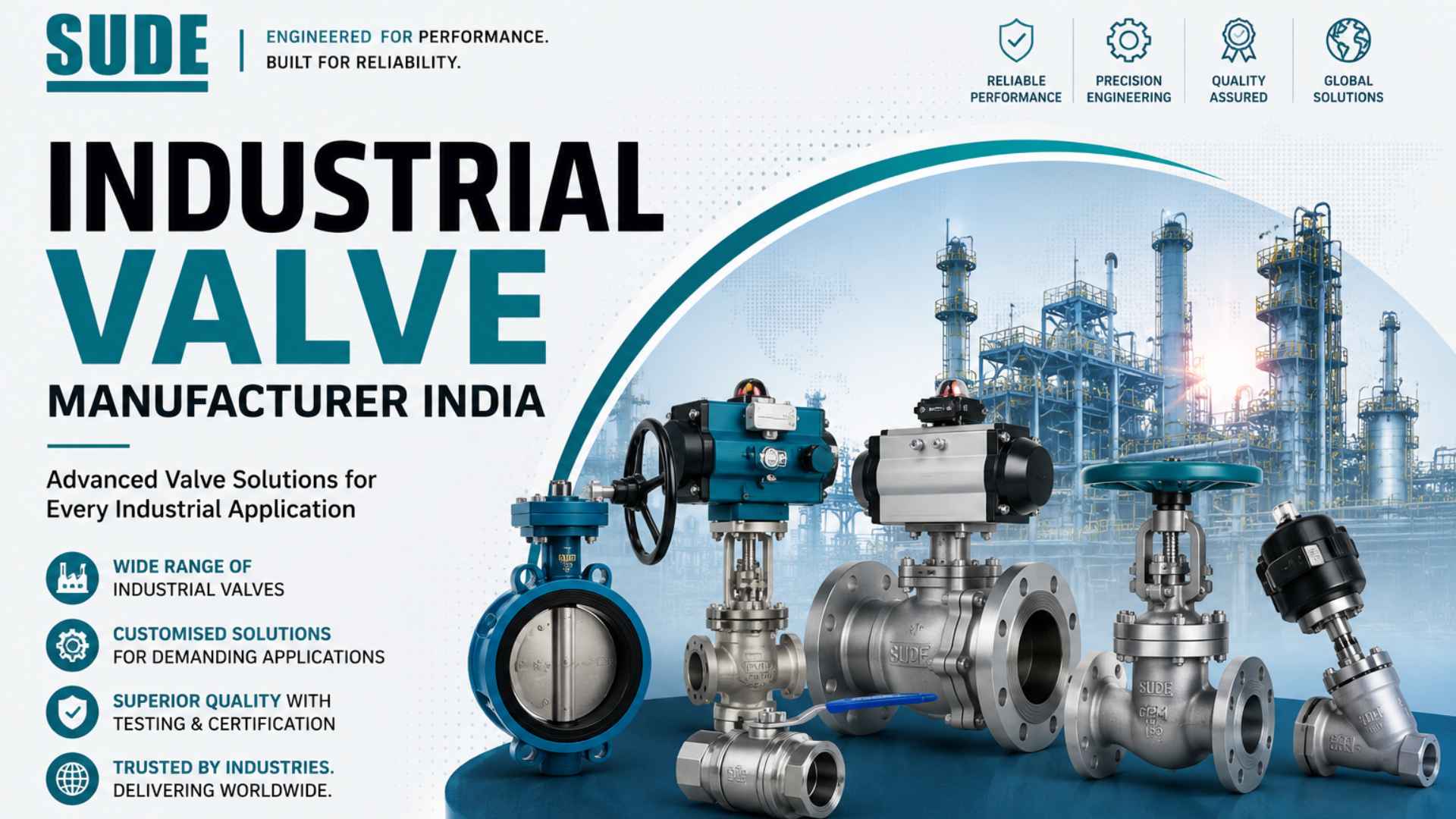
SUDE's current portfolio includes industrial valve categories such as angle valves, ball valves, butterfly valves, plug valves, zero-bacteria valves, diaphragm valves, and pinch valves. Its broader flow-control portfolio also includes automated valves, dampers, and actuators.
Butterfly Valves
Butterfly valves use a rotating disc to control flow and are commonly selected when compact construction, fast operation, and relatively low pressure drop are required.
SUDE's butterfly valve portfolio includes pneumatic and electric-operated metal and plastic butterfly valves. The company describes these valves as suitable for applications including water distribution, chemical processing, HVAC, power plants, wastewater treatment, and general industrial utilities.
Ball Valves
Ball valves use a rotating ball with a passage through it. They can provide rapid quarter-turn operation and are available in different configurations depending on the process.
SUDE lists 2-way and 3-way ball valve configurations, including L-port and T-port arrangements, along with full-bore and reduced-bore options. Its current product information also lists carbon steel, stainless steel, and engineering-plastic construction options.
Control Valves
Control valves are used when process flow needs to be continuously or repeatedly regulated rather than simply opened or closed.
SUDE offers electric-operated and pneumatic-operated 2-way and 3-way globe control valves and positions its control-valve portfolio around industrial flow regulation.
Diaphragm Valves
Diaphragm valves are used where contamination control, cleanability, chemical compatibility, or isolation between the process media and valve operating mechanism is important.
They can be particularly relevant in pharmaceutical, biotechnology, food, and clean-utility applications. SUDE's 1168 Series pneumatic diaphragm-seated stainless-steel valve is designed for applications including purified water, WFI distribution, clean steam, CIP/SIP systems, and sterile fluid handling.
Angle Seat Valves
Angle seat valves can be used for air, steam, gas, water, and other fluid services. Pneumatic actuation makes them useful where rapid automated operation is required.
SUDE offers pneumatic angle seat valves with configurations and accessories including pneumatic positioners, limit switches, proximity sensors, and electronic feedback options.
Pinch and Plug Valves
Depending on the media and process, pinch and plug valves can provide useful solutions for isolation and flow control. The correct choice should be based on the media properties, pressure, temperature, solids content, and required cycle frequency.
Why Choose an Industrial Valve Manufacturer in India?
India has a large and diverse industrial manufacturing base. Working with an Indian valve manufacturer can provide several practical advantages for domestic projects.
Engineering Support Closer to the Customer
Local engineering and manufacturing can make communication around drawings, specifications, site conditions, modifications, and technical approvals easier.
This is especially valuable for EPC projects where valve specifications may evolve during engineering and procurement.
Faster Communication
A manufacturer located in India can provide direct access to engineering, sales, production, and service teams without relying entirely on overseas communication channels.
Customised Solutions
Industrial valve requirements are not always standard.
SUDE states that it manufactures customised solutions based on size, pressure rating, temperature conditions, materials, and automation requirements. Its website also describes quality processes involving in-process and final inspections, testing reports, and traceability for orders.
Integration With Actuation
Modern plants increasingly require automated valve operation.
The valve and actuator need to work together as a system. SUDE's portfolio includes pneumatic, electric, and hydraulic actuator configurations for on-off and regulating applications.
This can be useful for plants implementing remote operation, PLC-based control, interlocking, position feedback, and automated process sequences.
How to Select the Right Industrial Valve
Choosing an industrial valve manufacturer in India is only one part of the procurement decision. The valve itself must also be correctly specified.
1. Understand the Process Media
Start by identifying exactly what will pass through the valve.
Important characteristics can include:
Liquid, gas, steam, or slurry
Corrosiveness
Viscosity
Solids or suspended particles
Toxic or hazardous properties
Cleanliness requirements
Material selection and valve construction should reflect the actual media.
2. Check Pressure Requirements
The valve must be suitable for both normal operating pressure and the applicable design conditions.
Pressure rating should be considered together with temperature because allowable pressure can change with temperature and material.
ASME B16.34 is one example of a widely used valve standard. The current 2025 edition covers pressure-temperature ratings, dimensions, materials, testing, marking, and other requirements for covered flanged, threaded, welding-end, wafer, and flangeless valves.
3. Evaluate Temperature
Temperature affects body material, seats, seals, packing, gaskets, lubrication, and actuator selection.
A valve suitable for ambient-temperature water service may not be suitable for high-temperature steam or process gas.
4. Determine the Required Valve Function
Ask what the valve actually needs to do.
Is the requirement:
On/off isolation?
Flow regulation?
Pressure management?
Diversion?
Mixing?
Non-return protection?
Emergency shut-off?
This helps determine whether a butterfly, ball, globe, diaphragm, plug, angle, or another valve design is appropriate.
5. Consider Valve Size
The nominal pipeline size is important, but correct sizing should also consider required flow, pressure drop, velocity, and control range.
An oversized control valve, for example, can make precise regulation difficult even though its physical connection matches the pipeline.
6. Determine the Actuation Method
Industrial valves may be manually operated or automated.
Electric actuators can be useful where electric power and precise positioning are required. Pneumatic actuators can be suitable where compressed air is available and rapid cycling is required. Hydraulic actuation may be considered for applications requiring high operating force.
The actuator should be sized according to the actual valve operating torque or thrust and the process conditions.
What Standards Should Industrial Valve Buyers Consider?
Standards should be selected according to the valve type, industry, application, and project specification.
For example, ASME B16.34 covers pressure-temperature ratings, dimensions, materials, testing, marking, and related requirements for several categories of industrial valves.
For petroleum and related applications, API publishes a range of valve standards. Its standards catalogue includes API 598 for valve inspection and testing, API 600 for steel gate valves, API 602 for smaller gate, globe and check valves, API 608 for metal ball valves, and API 609 for butterfly valves.
Quality management is another consideration. ISO 9001 defines requirements for a quality management system designed to help organisations consistently provide products and services that meet customer and applicable requirements while supporting continual improvement.
The key point is that buyers should not assume one standard applies to every valve. The appropriate specification should be established from the project, process, industry, and applicable codes.
Why Valve Testing Matters
A valve can look mechanically complete and still fail to perform correctly in service.
Testing and inspection help verify that the valve meets its specified requirements before delivery.
Depending on the product and project specification, testing may address:
Pressure integrity
Seat leakage
Functional operation
Dimensional requirements
Material verification
Actuator performance
Operating torque
Visual and dimensional inspection
API identifies API 598 specifically as Valve Inspection and Testing, illustrating the importance of inspection and testing as part of industrial valve quality assurance.
SUDE states that its products undergo strict in-process and final inspections and that it maintains quality records, testing reports, and traceability for orders.
Industrial Valve Manufacturer Pune: Why Location Matters
For companies searching for an industrial valve manufacturer in Pune, the location can be particularly useful for projects requiring engineering interaction, inspections, customisation, or ongoing support.
SUDE Engineering's manufacturing facility is located at Dhanore, Alandi Markal Road, Tal. Khed, Pune, Maharashtra, while the company's contact information also lists offices in Mumbai and Chennai.
Pune's industrial ecosystem also provides proximity to engineering, manufacturing, automotive, pharmaceutical, process, heavy-industry, and infrastructure companies.
For local buyers, this can make factory visits, technical meetings, inspection coordination, and project communication more convenient.
Industrial Valve Manufacturer India for Multiple Industries
Industrial valves are not limited to one sector. Different industries require different combinations of flow control, shut-off, regulation, automation, materials, and reliability.
SUDE identifies applications across critical sectors including power, oil and gas, steel, cement, nuclear, pharmaceuticals, water infrastructure, and other process industries.
Power Generation
Power plants require dependable flow control across water, steam, fuel, air, cooling, and other process systems.
Valve selection needs to consider high temperatures, pressure, cycling, safety, and maintainability.
Oil & Gas
Oil and gas applications can involve high pressure, hazardous media, corrosion, and stringent project specifications.
Valve selection in these environments needs to account for process safety, materials, pressure class, sealing, actuation, and applicable industry standards.
Steel and Cement
Steel and cement plants present challenging conditions involving heat, dust, abrasive materials, gases, and continuous operation.
SUDE's industry portfolio includes a broad range of valves, dampers, and actuators designed for heavy industrial applications.
Pharmaceutical Industry
Pharmaceutical facilities require carefully selected flow-control equipment, particularly for hygienic and contamination-sensitive services.
SUDE specifically offers hygienic valve solutions such as its stainless-steel diaphragm valve range for pharmaceutical and clean-utility applications.
Water and Infrastructure
Water distribution, wastewater treatment, and infrastructure projects generally require dependable isolation and flow-control solutions that can operate over long service periods.
Industrial Valve Exporter India: What Global Buyers Should Look For
An industrial valve exporter in India must be capable of more than shipping products internationally.
International buyers may require:
Detailed technical drawings
Material specifications
Inspection and test documentation
Traceability
Actuator details
Packing specifications
Commercial documentation
Country-specific requirements
Project-specific quality plans
The manufacturer's ability to communicate technical information clearly can be as important as the physical valve.
SUDE states that it serves customers in India and abroad and positions its manufacturing capability around high-performance valves, dampers, and actuation systems for demanding industrial environments.
For international projects, buyers should always confirm the exact applicable standards, certifications, testing requirements, documentation, delivery terms, and destination-country requirements before placing an order.
Why Customisation Matters in Industrial Valve Projects
Standard catalogue products are suitable for many applications, but complex projects may require specific configurations.
Customisation can involve:
Body materials
Seat materials
Pressure ratings
End connections
Port configurations
Trim materials
Special coatings
Actuator selection
Position feedback
Fail-safe arrangements
Special dimensions
Hygienic connections
SUDE's current website states that its valves and dampers can be customised according to size, pressure rating, temperature, material specifications, and automation needs.
This is particularly valuable when the valve is part of an engineered plant package rather than a simple replacement purchase.
Why SUDE Engineering?
SUDE Engineering has been involved in valve manufacturing and automation since its early years and was founded in Bangalore in 1989. The company subsequently expanded its manufacturing operations to Pune and now operates with facilities and offices serving customers across India and international markets.
Its current product portfolio covers industrial valves, dampers, pneumatic actuators, electric actuators, and control-valve solutions.
SUDE's value proposition is not limited to supplying individual components. Its portfolio allows valves and actuators to be considered together, which is useful for plants moving toward automated flow control.
The company's stated quality approach includes in-process and final inspection, testing reports, traceability, and approved-drawing-based production controls.
How to Choose an Industrial Valve Supplier for Your Project
Before selecting an industrial valve manufacturer, procurement and engineering teams should prepare a clear technical specification.
At a minimum, the enquiry should define:
Process: media, temperature, pressure, flow rate and operating conditions
Valve: type, size, pressure class, body material, trim and seat
Connections: flanged, threaded, welded, wafer, lug or another required configuration
Operation: manual, pneumatic, electric or hydraulic
Control: on/off, modulating, feedback, positioner or fail-safe requirement
Documentation: drawings, material certificates, inspection reports, test certificates and other project documents
Compliance: applicable codes, standards and customer specifications
A clear specification allows manufacturers to make a technically appropriate recommendation and helps buyers compare quotations on an equivalent basis.
Frequently Asked Questions
What is an industrial valve manufacturer?
An industrial valve manufacturer designs, engineers, manufactures, inspects, tests, and supplies valves for industrial process applications. Depending on its capabilities, a manufacturer may also provide customisation, actuation, automation, documentation, and technical support.
Which industries use industrial valves?
Industrial valves are used across power generation, oil and gas, chemical processing, steel, cement, pharmaceuticals, water treatment, food and beverage, HVAC, and other process industries. SUDE's current industry portfolio covers many of these sectors.
How do I choose an industrial valve manufacturer in India?
Evaluate the manufacturer's engineering capability, product range, manufacturing facilities, quality controls, testing processes, customisation capability, actuator integration, documentation, delivery capability, and after-sales support.
Is SUDE Engineering an industrial valve manufacturer in Pune?
Yes. SUDE Engineering lists its manufacturing facility at Dhanore, Alandi Markal Road, Tal. Khed, Pune, Maharashtra, India. The company specialises in valves, dampers, and actuation systems.
Does SUDE supply valves internationally?
SUDE states that it serves customers across India and abroad. International project requirements should be confirmed with the company based on the destination, valve type, applicable standards, testing, documentation, and project specification.
Can an industrial valve manufacturer provide customised valves?
Yes. Customisation may include size, pressure rating, temperature rating, materials, configuration, connections, and automation requirements. SUDE specifically states that it manufactures customised solutions based on these types of project requirements.
Conclusion
Selecting the right industrial valve manufacturer in India is a technical decision that can directly influence equipment reliability, process control, maintenance, and long-term operating performance.
The best manufacturer is not necessarily the one offering the lowest initial price. Buyers should consider engineering capability, manufacturing infrastructure, product breadth, material selection, testing, quality systems, customisation, automation, documentation, and service support.
For companies searching for an industrial valve manufacturer, an industrial valve manufacturer in Pune, or an industrial valve exporter in India, SUDE Engineering offers a broad flow-control portfolio covering industrial valves, control valves, actuators, dampers, and automated solutions.
With manufacturing operations in Pune, engineering experience dating back to 1989, and applications spanning power, oil and gas, steel, cement, nuclear, pharmaceutical, water, and other critical industries, SUDE Engineering is positioned to support both standard and customised industrial flow-control requirements.
Explore SUDE Engineering's industrial valve solutions:
https://www.sudeengg.com/
Related Posts
- Sep 30, 2026
- SUDE
- 10
Industrial Butterfly Dampers: Efficient Flow Control for Industries
Explore More
- Sep 18, 2026
- SUDE
- 10