

Check Dampers: Working Principle, Applications, Benefits & Selection Guide
- Damper
- Jun 22, 2026
- 177 Views
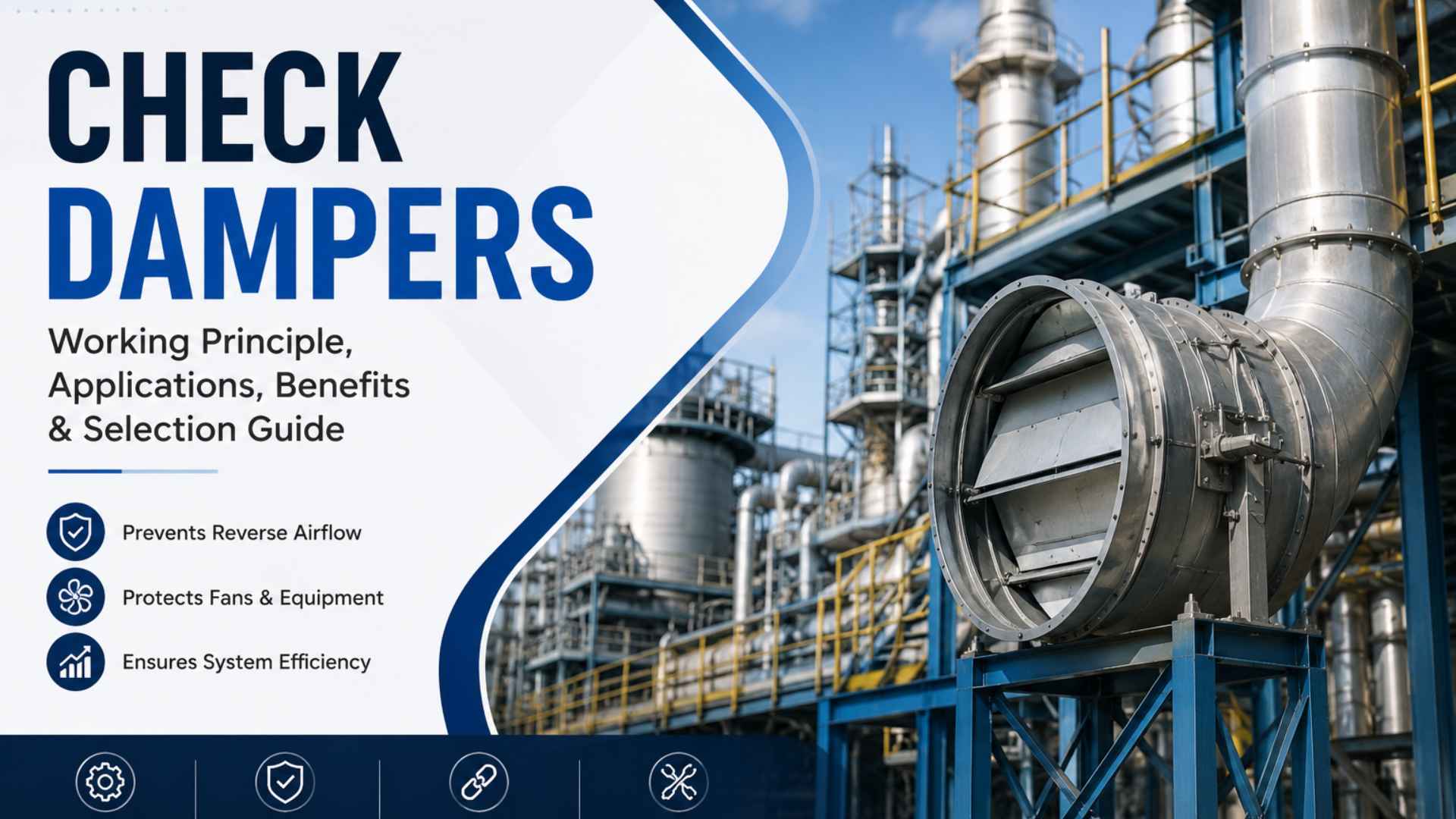
Check Dampers: Working Principle, Applications, Benefits & Selection Guide
In industrial air and gas-handling systems, controlling the direction of airflow can be just as important as controlling its volume. When airflow reverses unexpectedly, it can affect fans, filters, air-handling equipment, ducts, and other connected systems. A properly selected check damper provides an automatic way to prevent unwanted reverse airflow without requiring continuous manual intervention.
Also referred to as a non-return airflow damper in many applications, a check damper is designed to allow air or gas to move in the intended direction and automatically close when flow reverses or drops below the required operating condition. SUDE Engineering's Series 1927 Check Damper is specifically designed for non-return airflow in HVAC and industrial systems, including ventilation, exhaust, power generation, chemical processing, and other industrial applications.
For engineers, plant operators, consultants, and procurement teams, choosing the right check damper requires more than selecting a standard duct size. Flow direction, temperature, pressure, leakage requirements, installation orientation, media, construction materials, and closure mechanism all need to be considered.
What Is a Check Damper?
A check damper is a flow-control device designed to permit airflow in one direction while preventing reverse airflow.
Unlike a conventional regulating damper that may require an actuator or manual handle to change position, many check dampers operate passively. The airflow itself opens the damper, while gravity, springs, counterweights, or another closure mechanism returns the blades toward the closed position when airflow reverses or stops.
This operating principle makes check dampers useful in systems where automatic non-return protection is required.
SUDE Engineering describes its Series 1927 Check Damper as a non-return airflow device that works similarly to a check valve for air or gas. Its design allows free flow in one direction and automatically closes when the flow reverses.
How Does a Check Damper Work?
The working principle of a check damper is straightforward, but its performance depends heavily on correct design and installation.
Forward Airflow
When the system operates in the intended direction, the pressure and velocity of the moving air or gas push the damper blades open.
The blades move sufficiently to allow the required flow through the duct. A well-designed damper should provide the required airflow while keeping pressure loss reasonably low.
SUDE specifies low-pressure-drop operation in the open condition as one of the key features of its Check Damper Series 1927.
Reverse Flow
When the airflow direction changes, the blades move toward the closed position.
Depending on the design, this movement can be assisted by gravity, spring action, or counterweights. The objective is to stop or significantly restrict reverse airflow before it reaches connected equipment.
Loss of Airflow
A check damper can also close when the forward airflow falls below the force required to keep the blades open.
This makes the device useful in systems where the failure or shutdown of one fan should not allow air to travel backward through that branch.
Why Are Check Dampers Important in Industrial Systems?
Reverse airflow can create several operational problems.
For example, in a system with multiple fans connected to a common duct, an inactive fan may become exposed to airflow generated by another operating fan. Uncontrolled reverse airflow can also affect filtration equipment, ventilation paths, exhaust systems, and other connected components.
A check damper helps create directional airflow control.
Key benefits can include:
Automatic Non-Return Protection
The damper can respond to changes in airflow without requiring continuous operator action.
Protection of Connected Equipment
Preventing reverse airflow can help protect fans, filters, air-handling units, and other equipment connected to the system. SUDE specifically identifies fan, filter, and air-handling equipment protection among the intended functions of its Check Damper.
Low Pressure Drop
For systems where energy consumption and airflow performance matter, pressure drop through the damper is an important design consideration.
A damper that creates excessive resistance can increase the workload on fans and affect overall system performance.
Simple Operation
Passive check dampers can operate without external power, control wiring, or a continuously powered actuator. SUDE's Series 1927 uses passive operation based on gravity, spring tension, or counterweights depending on configuration and orientation.
Reduced Maintenance Complexity
A passive design can reduce the number of electrical and control components associated with the non-return function, although inspection and maintenance are still necessary for reliable operation.
Where Are Industrial Check Dampers Used?
Industrial check dampers are used in different airflow and gas-handling applications where reverse flow needs to be controlled.
1. Industrial Ventilation Systems
Industrial facilities often have multiple exhaust and ventilation branches. A check damper can help prevent air from moving backward through an inactive branch.
This is particularly useful in systems with multiple fans or interconnected ductwork.
2. Fan Discharge Systems
A check damper can be installed near fan discharge locations to help prevent reverse flow when the fan is stopped.
This can be important in parallel fan arrangements where operating one fan could otherwise push air backward through another fan.
3. Multi-Fan and Parallel Air Paths
In a multi-fan system, directional isolation can help maintain the intended airflow path.
SUDE lists multi-fan duct and parallel air-path systems among the applications of its Series 1927 Check Damper.
4. HVAC Systems
Check dampers are commonly used in supply, return, and exhaust air systems where directional airflow needs to be maintained.
SUDE specifies its Check Damper for commercial HVAC, cleanrooms, ventilation ducts, and industrial exhaust applications.
5. Power Plants
Power-generation facilities contain extensive air and gas-handling systems. SUDE lists Check Dampers among the dampers supplied for power-generation applications.
6. Chemical and Process Industries
Process plants can contain complex ventilation, exhaust, and gas-handling networks in which reverse flow may interfere with equipment or process conditions.
SUDE includes chemical processing among the applications for its Check Damper.
7. Cement and Steel Plants
Cement and steel plants operate large air and gas systems under demanding conditions. SUDE's Cement & Steel industry portfolio includes Check Dampers along with Butterfly Dampers, Isolation Dampers, Diverter Dampers, Guillotine Dampers, Stack Dampers, and other flow-control equipment.
Check Damper vs. Check Valve: What Is the Difference?
Although a check damper and a check valve perform a similar basic function, they are generally used in different types of flow systems.
A check valve is typically designed for liquid or gas flow through a closed piping system. A check damper is generally associated with air or gas movement through ducts, plenums, ventilation systems, and larger air-handling passages.
The exact design can vary by application.
For air and gas systems, damper construction can include single-blade, multi-blade, or butterfly-type arrangements. SUDE's Series 1927 supports rectangular or circular configurations and lists single-blade, multi-blade, and butterfly-type blade options.
The distinction is important when specifying equipment because the operating environment, pressure range, flow characteristics, leakage requirements, and installation arrangement may be very different.
Important Factors When Selecting a Check Damper
Selecting a check damper should begin with the operating conditions rather than the product name alone.
Air or Gas Flow
Identify the type of media passing through the damper.
SUDE's Series 1927 is specified for air or flue gas.
Size
Duct dimensions and required flow area determine the appropriate damper size.
SUDE lists standard sizes from DN 100 to DN 2000, with custom sizes available on request for its Series 1927.
Temperature
Temperature is particularly important in industrial environments.
SUDE specifies its Series 1927 for temperatures from -10°C to +100°C, with higher ratings available on request. This means applications involving hotter process streams should be reviewed against the actual design temperature and material/sealing requirements rather than assuming the standard configuration is suitable.
For genuinely high-temperature applications, the damper manufacturer should confirm the appropriate materials, seals, bearings, and operating arrangement.
Pressure
Pressure affects blade movement, sealing behaviour, mechanical loading, and the required construction.
SUDE describes Series 1927 as suitable for low to moderate static pressure.
For higher-pressure applications, engineers should confirm whether a check damper is the correct device and obtain application-specific sizing and performance data.
Installation Orientation
Installation orientation can affect how the blades open and close.
Gravity-operated or counterweighted arrangements need to be designed according to the actual mounting orientation. AMCA testing provisions for backdraft dampers also take mounting position and airflow direction into account, showing why installation configuration matters when evaluating damper performance.
Leakage Requirement
Not every application has the same allowable leakage.
Some systems simply need to prevent significant reverse airflow, while others require a more controlled leakage level.
SUDE lists low-leakage optional construction for its Series 1927.
Material of Construction
Material selection should consider temperature, corrosion, humidity, particulate loading, and the characteristics of the air or gas.
SUDE lists galvanized steel, aluminium, and stainless steel construction options for its Check Damper, depending on requirements.
What About High Temperature Dampers?
The term high temperature dampers is often used for dampers designed for hot air, flue gas, combustion systems, furnaces, kilns, boilers, and other elevated-temperature applications.
However, high-temperature service should always be treated as an application-specific engineering requirement.
The maximum operating temperature is not determined by the damper body alone. Seals, bearings, shafts, blade materials, coatings, clearances, and the method of operation can all affect suitability.
For example, SUDE's standard Series 1927 Check Damper is rated to 100°C, while higher temperature ratings are available on request. Therefore, a high-temperature requirement should be clearly specified during enquiry so the manufacturer can select the appropriate configuration rather than applying a standard HVAC damper to a process application.
For more demanding high-temperature gas systems, SUDE also manufactures other damper designs, including Butterfly Dampers, Double Eccentric Butterfly Dampers, Stack Dampers, Throttle Dampers, and Isolation Dampers.
Testing and Performance Considerations
When specifying a damper, buyers should look beyond basic dimensions and ask how performance is established.
ANSI/AMCA Standard 500-D provides laboratory test methods for dampers. The standard covers characteristics including air leakage, pressure drop, dynamic closure, and operational torque, as applicable to the damper being tested. AMCA states that the standard is intended to establish uniform laboratory test methods rather than define universal acceptability limits.
For a check or backdraft-style damper, engineers should therefore consider:
Airflow capacity
Pressure drop
Reverse-flow closure behaviour
Leakage performance
Operating temperature
Installation orientation
Mechanical durability
Required testing documentation
This information can help procurement teams compare products on engineering performance rather than price alone.
How to Choose a Check Damper Manufacturer
Choosing the right check damper manufacturer is particularly important when the equipment is being installed in a critical industrial process.
A manufacturer should be able to evaluate:
Required airflow and duct dimensions
Operating and design temperatures
Static and differential pressure
Flow media
Reverse-flow conditions
Installation orientation
Leakage requirements
Material and seal compatibility
Required testing and documentation
Manual or automated integration requirements
Application engineering matters because a damper that performs well in an HVAC application may not automatically be suitable for a hot, dusty, corrosive, or process-critical gas stream.
SUDE Engineering has specialised in dampers, valves, and actuation systems since 1989. The company says it has more than 40 years of engineering expertise and manufacturing facilities in Alandi, Pune, with products serving industries including power, oil and gas, steel, nuclear, and other critical applications.
Why Choose SUDE Engineering for Check Dampers?
SUDE Engineering's Check Damper Series 1927 is designed as a non-return airflow solution for HVAC and industrial systems.
The current product specification includes rectangular and circular configurations, DN 100 to DN 2000 sizing, air or flue-gas service, passive gravity/spring/counterweight operation, low-pressure-drop design, and optional low-leakage construction. Higher temperature ratings are available on request.
The broader SUDE portfolio also includes Butterfly Dampers, Double Eccentric Butterfly Dampers, Isolation Dampers, Stack Dampers, Throttle Dampers, and other products for power, cement, steel, chemical, HVAC, and process applications.
This broader product range is useful when a project requires more than simple non-return airflow control and needs a coordinated damper, valve, or actuator solution.
Frequently Asked Questions About Check Dampers
What is the main purpose of a check damper?
The main purpose of a check damper is to permit airflow in the intended direction and prevent or restrict reverse airflow. It is commonly used to protect connected equipment and maintain the designed airflow path.
Are check dampers automatic?
Many check dampers are passive and operate automatically using airflow, gravity, springs, or counterweights rather than requiring a continuously powered actuator.
Where are industrial check dampers used?
Industrial check dampers can be used in ventilation, exhaust, fan discharge, multi-fan duct systems, HVAC, power plants, chemical processing, cement plants, steel plants, and other air or gas-handling systems.
Are check dampers suitable for high-temperature applications?
They can be, but suitability depends on the specific design and materials. SUDE's standard Series 1927 is rated to 100°C, with higher ratings available on request. High-temperature applications should therefore be specified separately so the appropriate configuration can be engineered.
How is a check damper different from a backdraft damper?
The terminology varies by industry and manufacturer. In airflow systems, both terms can refer to devices designed to permit flow primarily in one direction and close when flow reverses. AMCA's damper testing materials specifically define and test backdraft dampers based on this one-direction airflow function.
Conclusion
Check dampers provide a simple and effective method of controlling unwanted reverse airflow in air and gas-handling systems. By allowing forward flow and automatically responding to reverse flow or loss of airflow, they can help protect fans, filters, air-handling units, ducts, and other connected equipment.
The correct damper should be selected based on the real operating conditions, including airflow, temperature, pressure, media, duct size, leakage requirements, installation orientation, and construction materials.
For standard HVAC systems, industrial ventilation, exhaust networks, power-generation applications, and other process environments, working with an experienced check damper manufacturer can help ensure the selected equipment is properly matched to the application.
For projects involving higher temperatures, the requirement should be communicated at the design stage so that suitable materials, sealing arrangements, and construction can be evaluated. High-temperature applications may also require other damper configurations depending on the process.
Explore SUDE Engineering Check Damper – Series 1927:
https://www.sudeengg.com/product/check-damper
Related Posts
- Sep 30, 2026
- SUDE
- 10
Industrial Butterfly Dampers: Efficient Flow Control for Industries
Explore More
- Sep 18, 2026
- SUDE
- 10